
Key Takeaways
- Digital Displacement: Specifically, Elon Musk noted that screen-based digital roles (like routine coding and data entry) will be automated far faster than physical, real-world jobs.
- Task Decomposition: Additionally, AI replaces repetitive tasks within jobs before eliminating entire occupations, creating massive leverage for workers who learn to use AI tools.
- Irreplaceable Human Traits: Overall, occupations requiring human empathy, moral judgment, accountability, creative vision, and physical adaptability remain the most resilient.
Executive Overview
Elon Musk recently issued a stark warning for the global tech workforce. Specifically, he stated that anything physical will exist much longer, whereas screen-based computer jobs will face rapid AI automation. Speaking on the future of labor, Tesla’s CEO outlined why screen-based, predictable activities are being automated first, while physical operations and human-centric judgment remain resilient.
For startup founders and software engineers, this prediction isn’t cause for panic. Instead, it provides a practical roadmap. As AI automates mechanical coding tasks, the value of a developer shifts from writing syntax to mastering system architecture, verification, and human accountability. Below, we analyze Musk’s workforce predictions and outline how tech workers can adapt.
Which Jobs Does Elon Musk Say AI Will Replace First?
Elon Musk explained that software will transform digital work long before it replaces physical jobs.
Specifically, the jobs most vulnerable to AI automation are those built around repetitive, predictable, and screen-based activities. If a role involves following fixed rules, processing large volumes of data, or producing standardized output, software can increasingly handle the work.
For example, junior administrative roles, basic data analysis, and routine software coding are already seeing heavy automation.
However, this transition does not mean tech jobs disappear overnight. Instead, software tools handle mechanical tasks, allowing human workers to focus on higher-level problem solving.
To understand why investor capital is moving toward physical hardware and robotics, read Tepi AI’s analysis on Why VCs Are Betting Billions on Physical AI Instead of Apps.

Why Do Physical Jobs Survive Longer Than Digital Computer Jobs Under AI?
Thermodynamics and physical robotics explain why physical jobs persist longer than purely digital roles.
In the digital realm, software algorithms scale instantly across millions of servers without physical friction. However, operating in the physical world requires complex robotics, sensors, spatial awareness, and fine motor control.
Consequently, trades like plumbing, electrical work, and specialized nursing will survive much longer than basic office data entry.
Until humanoid robotics reach mass production and lower cost structures, physical human labor remains far more cost-effective.
What Is Elon Musk’s Concept of Universal High Income vs UBI?
During his remarks at the US-Saudi Investment Forum, Elon Musk suggested that advances in AI and robotics could eventually make traditional work optional.
However, Musk distinguishes his vision of Universal High Income from standard Universal Basic Income (UBI).
Standard UBI provides a basic financial floor for food and shelter. In contrast, Universal High Income assumes that AI-driven automation creates so much physical abundance that goods and services become nearly free.
Under this post-scarcity model, people would work for personal purpose, interest, or social connection rather than financial necessity.
For insights into how foundational AI shifts impact startup strategy, explore Tepi AI’s guide on how Anthropic Just Changed How Smart Founders Should Build AI Startups.
How Will AI Task Decomposition Change Developer and Startup Founder Roles?
Rather than eliminating entire occupations overnight, AI changes work through task decomposition.
In practice, a job is a collection of individual tasks. AI models take over mechanical sub-tasks first, such as writing boilerplate code, formatting data, or drafting initial email templates.
Consequently, human workers shift from execution to evaluation, oversight, and decision-making when data is incomplete.
Workplace studies show that workers who learn to operate AI tools become significantly more productive. For instance, PwC’s 2026 AI Jobs Barometer revealed that workers possessing specialized AI skills command a 62 percent wage premium in technology markets.
Founders looking to track funding trends and hiring shifts can explore Why Smart Founders Track Funding Before They Raise.
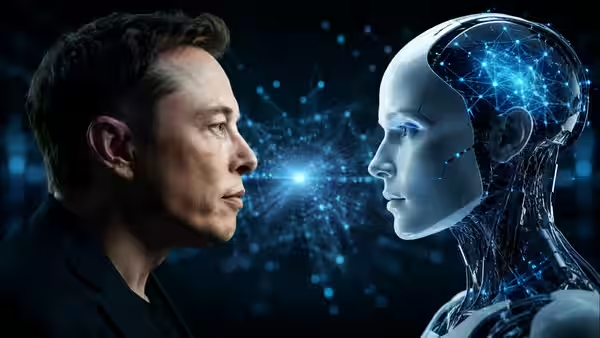
Which Human Skills Remain Irreplaceable in an AI-Driven Economy?
While AI excels at pattern recognition and text generation, key human capabilities remain difficult for machines to replicate.
Research from leading academic institutions identifies five irreplaceable human capabilities:
- Empathy & Relationships: Building deep trust with clients, managing team conflicts, and understanding emotional context.
- Accountability & Ethics: Taking legal, moral, and professional responsibility for final decisions.
- Complex System Architecture: Designing holistic software systems rather than merely generating individual code functions.
- Contextual Judgment: Making strategic business decisions when empirical data is ambiguous or missing.
- Creative Vision: Formulating original, non-obvious ideas that challenge established industry norms.
How Can Software Engineers Pivot From Syntax Writing to System Architecture?
For software developers, adapting to the age of AI requires moving up the technical value chain.
Instead of competing with AI on typing speed or syntax memorization, developers should focus on three core competencies:
- Master System Design: Focus on high-level system architecture, database modeling, and distributed system reliability.
- Prioritize Code Auditing: Develop strong security skills to review, test, and sanitize AI-generated code snippets.
- Understand User Needs: Focus on user experience design, product positioning, and business logic that AI cannot infer automatically.
Early-stage builders seeking structured mentorship and early investment access can review our analysis on Antler Residency: Should Startup Founders Apply?.
Actionable Takeaways for Startup Founders
- Embrace Human-AI Augmentation: First, structure your team so AI handles repetitive execution while humans retain final accountability.
- Upskill Your Engineering Team: Second, encourage developers to focus on system design, security auditing, and architectural review.
- Build Around Uniquely Human Needs: Third, focus product development on empathy, complex relationships, and physical-world integration.
- Access Founder Resources: Finally, for ongoing market analysis, startup news, and growth guides, explore Tepi AI’s Essential Insights for Founders and Startups.
Written by Arnav Bhardwaj