
The next major AI breakthrough might not come from writing better code or generating more realistic images. It could come from discovering entirely new materials.
Artificial intelligence is making rapid progress in software development, mathematics and scientific research. But one important frontier remains particularly difficult: understanding and predicting how materials behave at the atomic level.
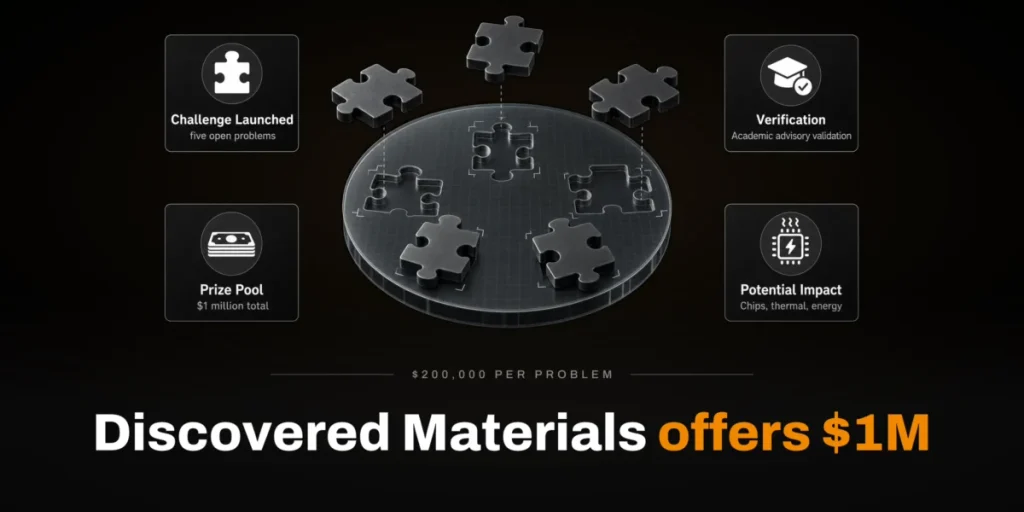
A San Francisco startup called Discovered Materials is taking an unusual approach to this challenge. Instead of simply building another AI model, it is putting $1 million in prize money behind five difficult, unsolved problems in materials science.
The bigger story is not just the money. It is the company’s attempt to establish measurable scientific challenges that can help determine whether AI is becoming capable of making meaningful discoveries in the physical world.
For founders, this development offers an interesting look at the intersection of AI, deep technology, semiconductor research and scientific entrepreneurship.
What happened? Five scientific problems, one ambitious challenge
The $1 million initiative is designed to reward solutions to five major problems that have remained difficult for researchers despite decades of scientific investigation.
The challenges cover several areas:
- Superconductivity: Developing a predictive theory explaining how cuprate materials achieve superconductivity.
- Semiconductor interfaces: Understanding how the manufacturing process affects the electrical properties of interfaces between materials used in chips.
- Quantum chemistry: Improving the accuracy and computational efficiency of methods used to simulate chemical reactions.
- Light and materials: Predicting how laser pulses change the behaviour of materials at the electronic and atomic levels.
- Heat transport: Understanding how heat moves across solid interfaces, an important problem for more energy efficient computing.
An important distinction: the five problems are not simply requests to generate new materials. They involve developing scientific theories and computational methods that explain or predict physical behaviour.
Discovered Materials says the prize pool is intended to establish measurable goals for AI progress in materials science. Its official challenge page describes the problems as open, verifiable and decades old. Discovered Materials+1
Who is Discovered Materials?
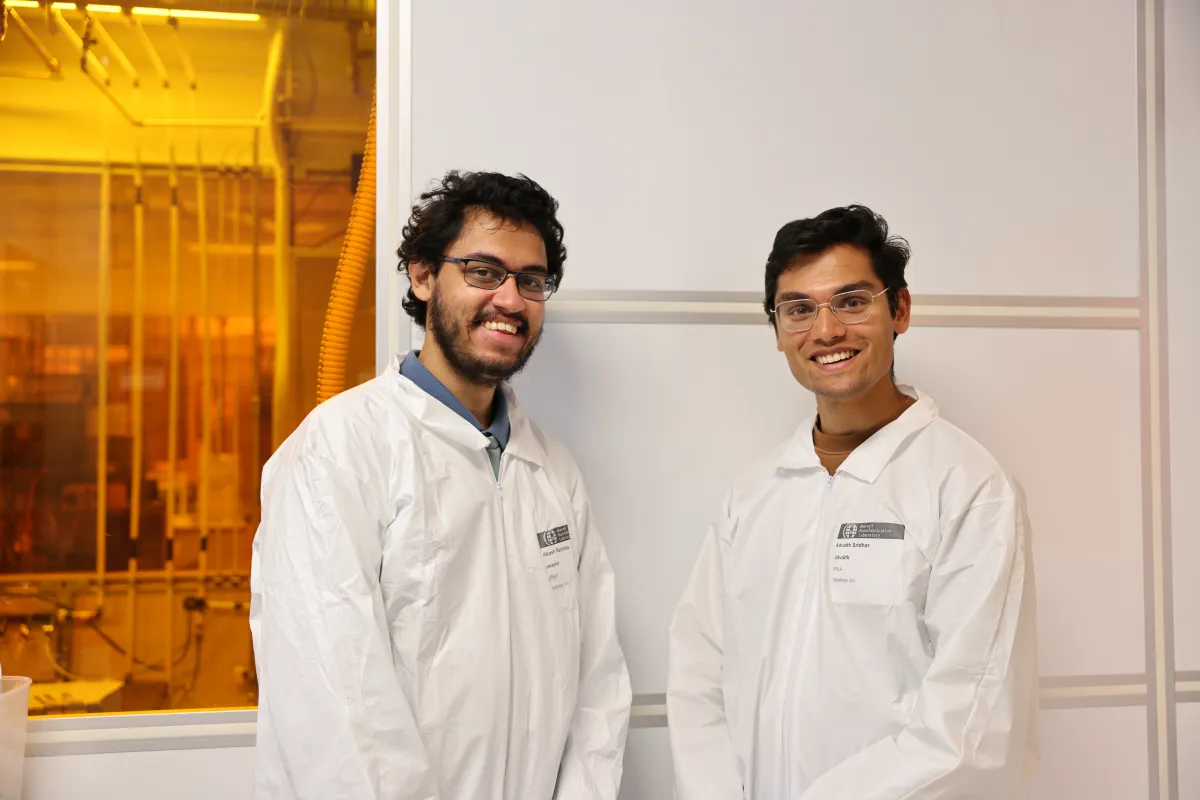
Discovered Materials is a San Francisco based deep technology startup founded by Advaith Sridhar and Akash Ramdas. The company emerged from Y Combinator’s Spring 2026 batch.
The founders bring together two complementary areas of expertise.
- Akash Ramdas has a PhD in Materials Science from Stanford University and has spent years researching materials for semiconductor chips.
- Advaith Sridhar has an AI background, including experience building AI models and agents at Persona AI and Luma Labs.
The company’s central idea is to use AI agents to accelerate the discovery of materials that could improve semiconductor performance.
The startup also attracted significant investor interest before announcing its latest challenge. In August 2026, it announced a $9 million seed funding round led by Lightspeed India Partners, with participation from Y Combinator, Peak XV Partners and angel investors including Paul Graham and Gokul Rajaram. Morningstar+2
How does its business model work?
Discovered Materials is not positioning itself as another general purpose AI software company. It is targeting a specific industrial problem: discovering and developing better materials for semiconductor manufacturing.
Its business model combines AI research, scientific simulation and industry collaboration.
The company uses AI agents to generate potential material candidates and computational methods to evaluate whether those candidates could work. Its research also involves simulation and experimental validation.
There are three important commercial opportunities here:
1. Industry research partnerships
The company works with semiconductor businesses on research projects. These partnerships can connect its scientific discoveries with real industrial requirements.
2. Intellectual property and licensing
If a newly discovered material proves commercially useful, the company could potentially protect its intellectual property and license relevant technology to manufacturers.
3. Proprietary research capabilities
Its AI agents, simulation workflows and scientific evaluation systems could become valuable assets in their own right.
The company has also described Material Discovery Bench, a benchmark for evaluating AI agents on real world semiconductor materials problems.
This matters because generating a promising scientific prediction is not the same as producing a material that works reliably in a factory. Verification is essential.