Nvidia built the infrastructure powering the AI revolution. Now, its biggest challenge is unfolding inside its own leadership.
For years, Jensen Huang has been the face of Nvidia’s extraordinary rise. His signature leather jacket, ambitious vision and ability to anticipate the demand for AI computing have made him one of the most influential executives in technology.
But the Nvidia CEO is now at the centre of a controversy that has moved far beyond his personal life.
What began with Huang acknowledging an extramarital affair has developed into a wider corporate story involving allegations of foreign intelligence activity, a second reported relationship with a senior Nvidia executive, questions about board oversight, and growing political attention in Washington.
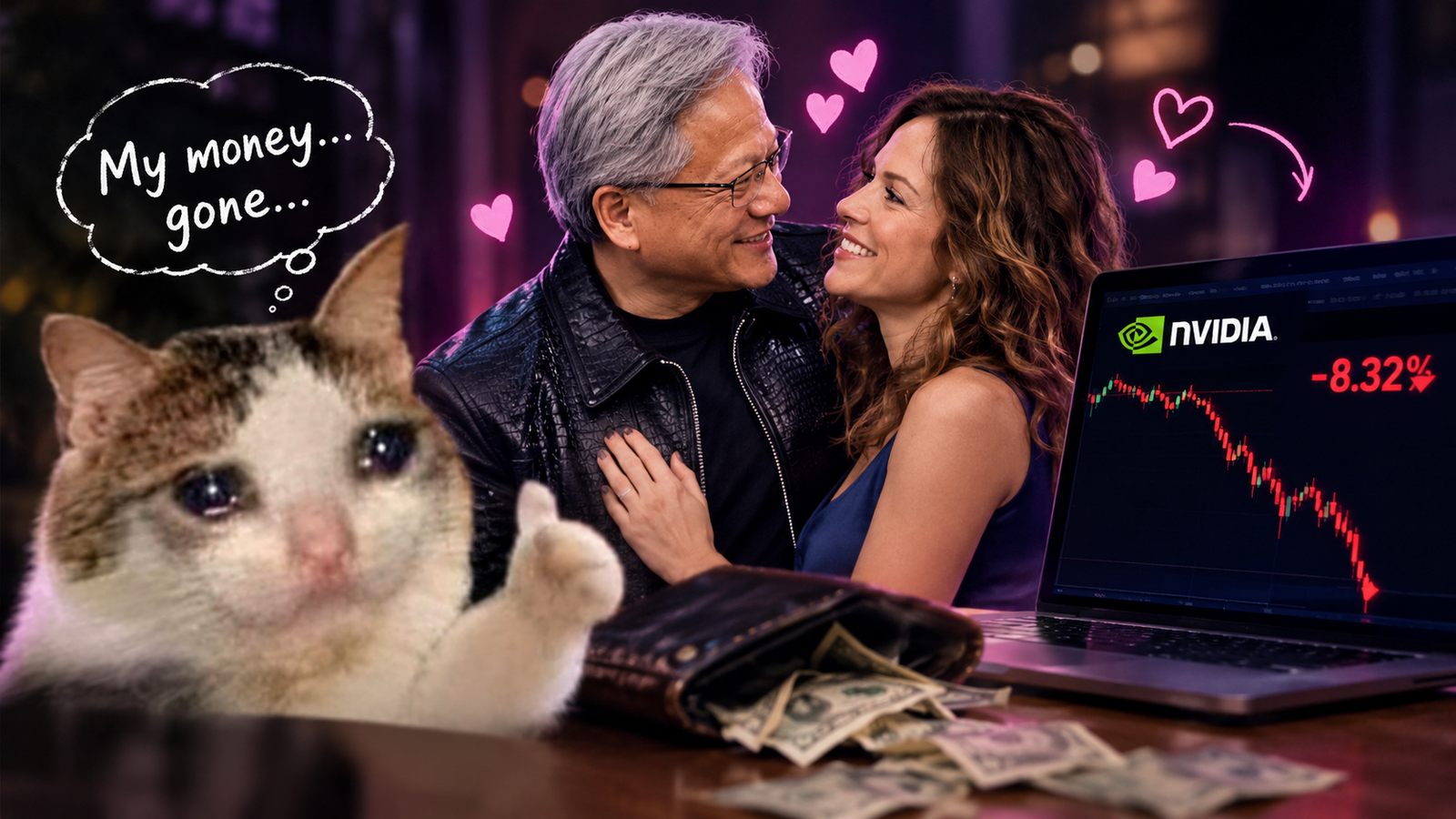
The latest development is particularly significant: The Wall Street Journal reported that Nvidia’s board was preparing to discuss Huang’s future at the company. TechCrunch also reported that Nvidia shares fell around 8% in after-hours trading on November 11.
The situation raises a question investors cannot ignore:
Can Nvidia protect its position in the AI industry if uncertainty surrounding its founder begins to threaten confidence in its leadership?
Let’s examine what has happened, why the situation matters, and what it could mean for Nvidia’s future.
1. How the Jensen Huang controversy began
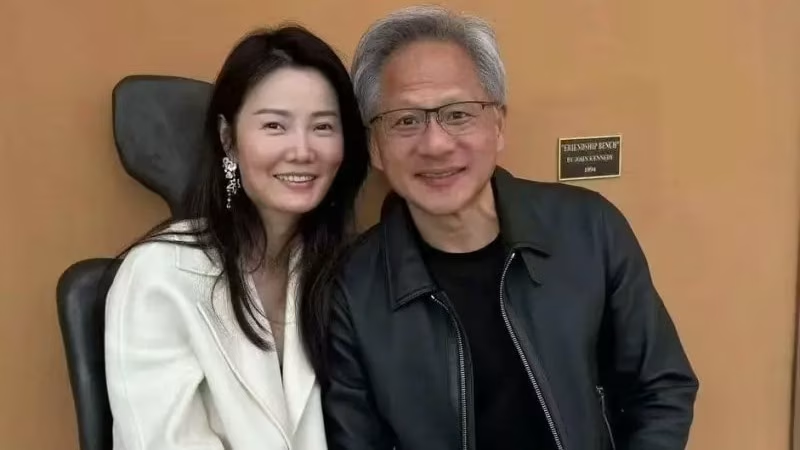
The first major reports connected Huang to Alice Huang, a former executive at Megaspeed, a Singapore-based AI infrastructure company.
According to reporting by The New York Times, US officials had been investigating concerns surrounding Megaspeed and its possible connections to efforts to obtain restricted Nvidia AI chips for Chinese customers.
The reports also alleged that US intelligence officials suspected Alice Huang of having links to Chinese intelligence activities.
These allegations have not been established as facts in a public investigation. Alice Huang’s identity and alleged intelligence connections should not be treated as proof of espionage.
On November 8, Jensen Huang acknowledged in a message to Nvidia employees that he had been unfaithful to his wife. He apologised to his family and colleagues and accepted responsibility for his actions.
Nvidia’s board simultaneously announced an independent investigation into reports that its CEO had been targeted by a foreign intelligence effort.
The board said a committee of independent directors, assisted by outside independent counsel, would oversee the investigation.
Crucially, it stated that it had no reason to believe national security or Nvidia’s confidential information had been compromised.
That was the position when the controversy first became public. But the story did not stop there.
2. The New York Times reports a second relationship involving an Nvidia executive
On November 11, The New York Times reported another development: Huang allegedly had an extramarital relationship with Kimberly Powell, Nvidia’s vice president of healthcare, who reportedly reports directly to him.
The report cited five people who had worked at Nvidia.
According to the reporting, Huang and Powell were seen being affectionate at a hotel during a conference earlier in 2026.
Neither Huang nor Powell had publicly confirmed the reported relationship in the coverage available at the time. Nvidia had not immediately responded to Reuters’ request for comment.
This development matters for a reason beyond Huang’s personal life.
If a CEO has a relationship with an executive who reports directly to him, it raises questions about workplace power dynamics, conflicts of interest, disclosure obligations and the company’s internal governance.
Investors may want to know:
- Were company policies followed?
- Was the relationship disclosed to the appropriate people?
- Were reporting arrangements or performance decisions affected?
- Did the board know about the relationship?
- Were there safeguards to prevent conflicts of interest?
These are legitimate governance questions. However, the existence of a reported relationship does not by itself establish that company policies were violated.
The board’s independent review and any further company disclosures will be important.
3. Nvidia’s board may discuss Huang’s future

Perhaps the most consequential development is the report that Nvidia’s board is preparing to discuss whether Huang should continue as CEO.
According to The Wall Street Journal, the board was preparing to meet to discuss his future following the latest revelations.
This is a significant escalation from the board’s November 8 statement, which expressed confidence in Huang and his leadership team while announcing an independent investigation.
However, a reported discussion about a CEO’s future is not the same as a confirmed decision to remove that CEO.
As of November 12, there has been no confirmed announcement that Huang has resigned or been removed.
The board now faces a difficult balancing act.
Huang has led Nvidia for more than three decades. He is deeply connected to its strategy, product direction, customer relationships and corporate identity.
Removing him could create uncertainty at a company whose market position is closely associated with his leadership.
Keeping him without addressing legitimate governance concerns could also create problems with employees, shareholders, regulators and customers.
The board must consider both sides.
4. Why Washington is paying attention
This controversy is not limited to Nvidia’s shareholders.
The allegations involve a company operating at the centre of the US-China technology competition.
Nvidia designs advanced processors that are essential for training and running powerful AI systems. Access to these chips has become a strategic issue because AI computing capacity has implications for economic competitiveness, scientific research and national security.
The US has imposed restrictions on exports of certain advanced semiconductor products to China.
Megaspeed’s reported business relationships and the questions surrounding access to restricted chips have therefore attracted attention from US authorities.
The political response is also growing.
TechCrunch reported that three Republican committee chairmen had requested a closed-door briefing with Huang. On November 11, House Select Committee on China Chairman John Moolenaar said Huang could face a subpoena if he did not agree to the requested briefing.
A congressional request or potential subpoena is not evidence of wrongdoing. It does, however, demonstrate that the controversy has become a matter of political and national security interest.
For Nvidia, this creates another layer of uncertainty.
The company must continue managing its global business while responding to questions about export controls, customer relationships and executive security.
5. Nvidia stock reacts as investor confidence comes under pressure
<badge color=”danger”>Market pressure</badge>
The financial markets have not ignored the developments.
TechCrunch reported that Nvidia shares fell approximately 8% in after-hours trading on November 11, following the latest reports. The stock was also down around 11% over the preceding five trading days, according to the same report.
These figures describe different time periods and should not be confused with a confirmed regular-session closing loss of 8%.
Why is the market reacting?
Because Nvidia’s valuation depends on more than its latest chip launches or revenue growth. Investors also price in the company’s ability to execute its strategy, maintain customer confidence, manage regulatory risks and provide stable leadership.
The controversy creates several sources of uncertainty:
Leadership risk: Investors may question whether Huang will remain in his role and whether Nvidia has a credible succession plan.
Governance risk: The reported relationship with a direct-report executive could raise questions about internal controls and board oversight.
Regulatory risk: The intelligence allegations and chip export concerns could attract greater scrutiny from US authorities.
Reputational risk: Customers, employees and institutional investors may seek greater clarity about the company’s leadership and governance.
A stock decline does not prove that Nvidia’s underlying business has weakened. It shows that investors are reassessing uncertainty and potential risks.
6. The biggest problem could be Nvidia’s dependence on Jensen Huang
This is where the story becomes particularly important for long-term investors.
Jensen Huang is not simply the CEO of Nvidia. He is one of the central figures behind the company’s identity and strategic direction.
He co-founded Nvidia in 1993 and has led the company through several major technological shifts, from graphics processors to accelerated computing and AI infrastructure.
His influence is unusually extensive.
Huang has previously said that approximately 60 senior executives report directly to him. This structure reflects his hands-on management approach, but it also raises questions about how much decision-making is concentrated around one individual.
Consider what could happen if Nvidia suddenly needed a leadership transition:
- Major strategic decisions could face delays.
- Investors might question the company’s ability to maintain execution.
- Customers could seek reassurance about product roadmaps and partnerships.
- Senior executives might face uncertainty about reporting structures.
- The board could come under pressure to demonstrate that succession planning is credible.
This is known as key-person risk.
A company can have outstanding technology and strong financial results while still being vulnerable to excessive dependence on one executive.
Nvidia’s current situation makes that risk more visible.
7. Could Nvidia’s business survive without Huang?
The question is uncomfortable, but it deserves attention.
Nvidia’s success is not based on Huang alone.
The company has built an extensive ecosystem that includes:
- GPUs and specialised AI accelerators
- CUDA software and developer tools
- Networking and data-centre infrastructure
- Strong relationships with cloud providers
- Partnerships with leading AI companies
- A global engineering and research organisation
These assets have been developed over decades by thousands of employees.
They do not disappear if the CEO leaves.
However, leadership transitions at companies of Nvidia’s scale are complicated. Huang has played a central role in defining the company’s strategy, communicating its vision and building relationships with major customers.
A sudden departure could therefore create short-term uncertainty even if the company’s technology and operations remain intact.
The long-term impact would depend on the strength of Nvidia’s executive team, the quality of its succession plan and the board’s ability to manage a transition.
There is currently no confirmed announcement of a CEO change.
8. Nvidia’s competitors could benefit from the uncertainty
A leadership controversy does not automatically make Nvidia’s competitors stronger. However, it could create an opportunity for customers to reassess their dependence on a single supplier.
The AI chip market is already becoming more competitive.
AMD: Its Instinct accelerator family offers an alternative for companies looking to diversify their AI computing infrastructure.
Google: Its Tensor Processing Units are designed to support Google’s own AI workloads and cloud customers.
Amazon: AWS develops Trainium and Inferentia chips to provide alternatives for AI training and inference.
Broadcom: It works with major technology companies on custom AI accelerators and networking solutions.
These businesses are competing on performance, price, energy efficiency, availability and software compatibility.
Nvidia still has major advantages, especially its CUDA ecosystem and broad range of AI infrastructure products.
But a controversy surrounding its leadership could encourage large customers to strengthen their multi-vendor strategies.
That would be a commercial development worth watching, regardless of the outcome of the investigation.
9. Three possible scenarios for Nvidia’s future
Rather than assuming that the controversy will produce a particular stock price or leadership outcome, it is more useful to examine three possible scenarios.
Scenario 1: Huang remains CEO and the investigation finds no material compromise
In this situation, the board could reaffirm its confidence in Huang after completing its review.
If the investigation finds no evidence that Nvidia’s confidential information or national security information was compromised, and no major compliance failures emerge, the company could gradually return investors’ attention to its core business.
The board may still need to strengthen disclosure, governance and succession planning.
What to watch: The investigation’s findings, board statements, Huang’s public appearances and Nvidia’s financial performance.
Scenario 2: Huang remains CEO, but governance concerns persist
The investigation may not establish a national security breach, but questions surrounding executive conduct and internal governance could remain.
This could create a prolonged period of uncertainty.
Investors may demand clearer reporting structures, stronger internal controls and greater independence between management and board oversight.
Nvidia could continue growing while its stock experiences volatility.
What to watch: Board actions, employee and executive changes, customer confidence and institutional investor responses.
Scenario 3: Nvidia moves towards a leadership transition
If the board concludes that the controversy has materially affected the company’s leadership or governance, it could consider a change in executive responsibilities or a succession process.
A transition would not automatically damage Nvidia’s long-term business. Much would depend on who takes over, how smoothly the process is managed and whether customers and employees remain confident.
However, an unexpected departure by a founder with such a central role could create substantial short-term uncertainty.
What to watch: Official board announcements, executive appointments and any confirmed changes to Huang’s responsibilities.
These are scenarios, not predictions. The investigation has not produced a final public finding.
10. What investors should monitor next
The next phase of this story will be determined by developments that go beyond headlines.
| Development | Why it matters |
|---|---|
| Nvidia board investigation | Could clarify whether confidential information or security controls were compromised |
| Board discussion about Huang | May reveal whether leadership continuity is at risk |
| Congressional action | Could increase political and regulatory scrutiny |
| US export-control developments | May affect Nvidia’s access to international customers |
| Nvidia’s management disclosures | Could provide clarity on governance and succession planning |
| Customer and partner reactions | May reveal whether confidence in Nvidia’s leadership is changing |
| Stock and earnings performance | Will help distinguish business fundamentals from controversy-driven volatility |
Investors should also separate short-term trading reactions from long-term business performance.
A sharp fall in after-hours trading can reflect uncertainty and changing expectations. It does not, by itself, establish that Nvidia’s revenue, technology or competitive position has deteriorated.
Final verdict: Nvidia’s biggest test may be leadership, not technology
Nvidia remains one of the most important companies in the global AI industry.
Its GPUs, software ecosystem and data-centre infrastructure have helped make modern AI possible. The company has a powerful competitive position, significant customer relationships and a large engineering organisation.
But the latest controversy has exposed a question that investors cannot afford to ignore: how resilient is Nvidia’s leadership structure if Jensen Huang’s position becomes uncertain?
The reported second relationship has intensified questions about executive conduct. The foreign intelligence allegations have brought national security into the discussion. Reports of a possible board meeting about Huang’s future have added another layer of uncertainty.
None of this establishes that Nvidia’s secrets were compromised or that Huang has committed an offence. Those questions require evidence and due process.
The company’s board now needs to demonstrate that its investigation is genuinely independent, its governance standards are strong, and its business can operate with confidence regardless of the outcome.
Nvidia helped build the infrastructure for the AI revolution. Now it faces a different test: proving that a company worth trillions of dollars is bigger than the person who leads it.
The next few weeks could be important for Nvidia’s leadership, its investors and the wider AI industry.
Editorial disclaimer: This article analyses publicly reported developments available as of November 12, 2026. Allegations remain subject to investigation. Reported board discussions do not constitute a confirmed decision to remove Jensen Huang. This article is for informational purposes and is not investment advice.
Sources
- The New York Times, November 11, 2026: Reporting on the alleged relationship involving an Nvidia executive.
- BBC News, November 2026: Live coverage of developments surrounding Jensen Huang and Nvidia.
- Reuters: Reporting on Nvidia’s independent investigation and the allegations involving foreign intelligence.
- TechCrunch, November 11, 2026: Timeline of the unfolding Jensen Huang controversy.
- Nvidia Board of Directors, November 8, 2026: Official statement announcing the independent investigation.