

Key Takeaways
Shift from Intelligence to Usefulness: AI evaluation is moving away from raw parameter scale and generic leaderboards toward real-world performance testing in noisy, localized deployment scenarios.
Flaws in Generic Benchmarks: Standard global leaderboards often mask severe localized errors. Studies referenced by Analytics India Magazine show top transcription models suffer word error rates above 55% in regional languages like Maithili and Tamil.
Evaluation as Shared Infrastructure: Frameworks like Voice of India treat multilingual AI model evaluation as continuous post-deployment auditing rather than a one-time score, creating a mirror for vendors to catch failure modes before shipping.
Introduction
You just shipped an AI voice agent boasting 95% benchmark accuracy, only for it to confuse “15 lakh” ($18,000) with “50 lakh” ($60,000) on its first live customer call.
In enterprise software, standard leaderboard scores are often vanity metrics. Lab performance rarely reflects what happens when an AI model meets real-world noise, regional accents, and complex local business terms. To build software that retains users and wins enterprise contracts, founders and tech leads need testing frameworks that measure operational utility rather than abstract intelligence.
Here is how AI4Bharat’s new Voice of India platform is changing multilingual AI model evaluation, and what your team must do to audit models before shipping to production.
What is the Voice of India AI Evaluation Framework?
The Voice of India platform is an independent, multimodal evaluation framework created by research lab AI4Bharat and Josh Talks AI. It tests AI models across regional languages, accents, dialects, and practical deployment scenarios.
Instead of relying on vendor-reported figures or English-centric leaderboards, enterprises and public sector teams can evaluate models based on real-world utility. The platform tests performance across core sectors including banking, healthcare, agriculture, and public administration.

AI4Bharat was co-founded in 2019 at IIT Madras by Associate Professor Mitesh Khapra and Pratyush Kumar from Sarvam AI. Over seven years, the team has built extensive multilingual datasets, open-source models, and specialized benchmark suites. Multilingual AI model evaluation is the systematic testing of artificial intelligence systems across multiple human languages to measure accuracy, dialect comprehension, and contextual reasoning in localized environments.
How Does AI4Bharat Test AI Claims Across Regional Dialects and Accents?
Traditional leaderboards focus primarily on broad language fluency or isolated reasoning questions. Voice of India tests models on actual operational tasks.
For instance, the platform evaluates whether a voice agent can comprehend Bhojpuri spoken inside a crowded bank branch. It tests whether optical character recognition (OCR) correctly parses multilingual government documents, and whether legal assistants reason accurately over local statutes.
AI4Bharat’s research team previously released the FOCUS benchmark, exposing how vision-language models often fail when acting as evaluators for other models. Their evaluations of automatic speech recognition (ASR) systems across 15 languages and over 35,000 speakers highlighted significant accuracy gaps between lab settings and everyday conversational environments.
Why Are Western AI Benchmarks Failing in Non-English Deployments?
Most global benchmarks measure general cognitive reasoning using dataset formats designed primarily around Western English contexts. When these models face non-English languages, regional dialects, or domain-specific vocabulary, performance degrades rapidly.
Data from AI4Bharat revealed that leading Western transcription models logged word error rates exceeding 55% on Indian speech datasets. In regional languages like Maithili and Tamil, these systems failed to transcribe nearly two out of every three words correctly.
For enterprise deployments, these systemic gaps carry major financial risks. In financial conversations, mistranslating “15 lakh” as “50 lakh” changes transaction values entirely. In healthcare settings, transcribing the Hindi term for epidemic (mahamaari) as a proper noun (Mahavir) renders diagnostic tools unreliable.
What Causes High Error Rates in Multilingual Speech Recognition Models?
High error rates stem from three primary technical factors: background ambient noise, regional code-switching, and sparse localized training data. Code-switching occurs when speakers mix English terminology directly into native sentence structures.
Generic leaderboards obscure these failure modes by averaging accuracy across entire languages. A model might achieve a 90% average score on clean news broadcasts while failing entirely on conversational audio recorded over low-bandwidth mobile calls.
Without targeted evaluations across specific accents and domain terms, engineering teams remain unaware of critical edge-case failures until users report them in production.
Why is AI Model Evaluation Becoming as Important as Model Training?
Mitesh Khapra, Head of AI4Bharat, notes that evaluation directly determines what software gets built. As AI becomes embedded in core business workflows, rigorous testing becomes just as vital as model architecture design.
For the past several years, the tech industry has focused heavily on compute capacity, GPU clusters, and foundational model building. However, training data for major languages is now widely accessible, making output evaluation the primary bottleneck in production deployment.
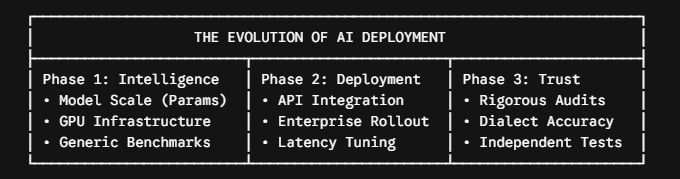
India has built shared Digital Public Infrastructure (DPI) through platforms like Aadhaar, UPI, and ONDC. Independent evaluation frameworks are following a similar path, acting as shared infrastructure that developers and enterprises can build on rather than proprietary silos.
How Do You Audit Multilingual AI Models Post-Deployment?
Auditing AI models requires shifting from static, one-time leaderboard checks to continuous post-deployment evaluation. Vendor claims need independent verification before teams sign SLAs or integrate third-party APIs into mission-critical systems.
Continuous evaluation platforms act as mirror exams for engineering teams. Instead of treating benchmarks as a pass-fail test, developers use detailed failure reports to patch localized data gaps and fine-tune model weights.
Josh Talks AI co-founder Shobhit Banga points out that major AI laboratories actively seek detailed benchmark reports because they highlight exact geographic and dialect-level failure points that internal QA teams miss.
What Metrics Should B2B Tech Leads Track Before Shipping AI Products?
Engineering leads evaluating conversational AI or multilingual LLM pipelines should measure four core operational metrics prior to production deployment:
- Domain-Specific Word Error Rate (WER): Measures transcription accuracy on industry vocabulary (e.g., medical terms, legal phrasing, financial numbers) rather than conversational prose.
- Contextual Entity Recognition Rate: Tracks how reliably the model extracts named entities, numbers, and dates in local languages and accents.
- Code-Switching Comprehension: Evaluates how effectively the model processes sentences that alternate between English and regional languages.
- Dialect-Specific Fallback Rate: Measures how frequently the system routes low-confidence responses to human agents when encountering non-standard regional accents.
Conclusion
The future of enterprise AI lies in verifiable performance. Building larger models is no longer sufficient; engineering teams must prove that their systems perform reliably across every accent, dialect, and operating environment they serve.
By establishing independent evaluation frameworks, platforms like AI4Bharat and Voice of India are defining a new standard for AI verification. For founders and engineering leads, adopting continuous, localized model auditing is the surest way to transition AI from lab demonstration to reliable enterprise software.
– Written by Shubham Singla