
What if gold could be manufactured instead of mined? A San Francisco startup is exploring exactly that possibility, raising a question that could reshape the future of one of the world’s most precious metals.
For centuries, turning ordinary metals into gold was considered an alchemist’s dream. Now, a fusion energy startup called Marathon Fusion says it has taken a step toward making that dream a scientific reality.
On October 21, 2026, the company announced that it had converted mercury into stable gold using fusion-generated neutrons. It claims its production rate exceeded a record set by CERN by a factor of 10. However, the result has not yet been independently verified, and the company has not disclosed how much gold it produced. Source: NDTV Profit
The announcement has sparked a bigger question: Could technology eventually make gold so abundant that its prices collapse?
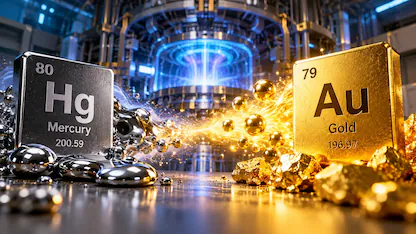
How Can Mercury Turn Into Gold?
The secret lies in nuclear physics.
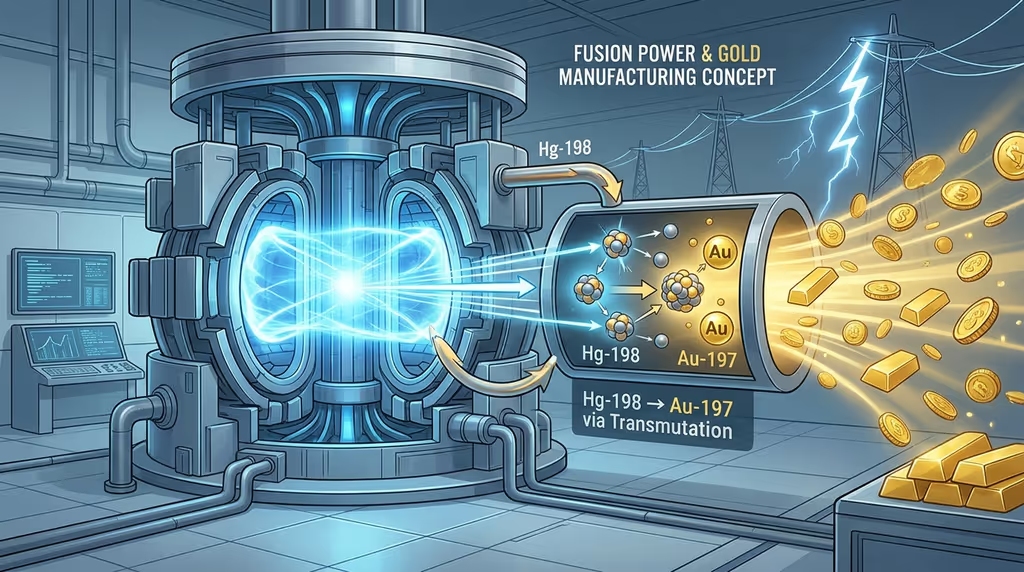
Marathon Fusion’s proposed process uses high-energy neutrons generated by nuclear fusion to transform mercury-198 into mercury-197. This radioactive isotope then decays into gold-197, a stable isotope of gold.
Unlike chemical reactions, which rearrange atoms without changing one element into another, nuclear reactions can change an atom’s identity.
The concept is not entirely new. Scientists at CERN previously produced tiny quantities of gold during experiments at the Large Hadron Collider. Marathon Fusion’s approach aims to explore whether fusion technology could make the process more scalable.
In a 2025 research presentation, the company described a theoretical configuration that could produce approximately two tonnes of gold annually per gigawatt of thermal fusion power. That figure is based on simulations, not demonstrated commercial production. Source: American Physical Society
Could This Crash Gold Prices?
This is where things get interesting.
Gold’s value depends partly on its scarcity, the difficulty of extracting it, its role in jewellery, and its importance as a financial reserve asset.
If technology eventually enables manufacturers to produce large quantities of gold at competitive costs, additional supply could put downward pressure on prices.
The comparison with lab-grown diamonds is tempting. Advances in manufacturing made synthetic diamonds much cheaper, putting pressure on prices in the lab-grown diamond market and changing how consumers view diamond jewellery.
But gold is a different story.
Lab-grown diamonds can be produced through established industrial processes. Fusion-generated gold, by contrast, requires complex nuclear technology, careful handling of radioactive materials, and a commercially viable production process.
Marathon Fusion has not demonstrated that its approach can deliver market-ready gold at competitive prices. Radioactive byproducts and the potential need for extended storage before the material can be sold also present significant challenges.
For now, the prospect of cheap, mass-produced gold remains speculative.
The Bigger Opportunity May Be Fusion Energy
Interestingly, gold may not be the company’s biggest opportunity.
Marathon Fusion is developing technology for future fusion power plants. Its research explores whether producing gold as a byproduct could create an additional revenue stream alongside electricity generation.
The idea is ambitious: if fusion power becomes commercially viable, the same technology might eventually help produce valuable materials while generating energy.
However, commercial fusion power remains a major engineering challenge. Turning an interesting scientific result into an economically competitive industrial process will require much more than a successful experiment.
What Should Investors Make of This?
Gold prices will not automatically crash because one startup has announced a potential breakthrough.
The amount of gold produced, the cost of production, independent verification, regulatory requirements, and the ability to scale the technology will all matter.
Gold’s role in central bank reserves and financial markets also extends beyond its availability as a raw material.
For now, there is no demonstrated commercial supply of fusion-produced gold capable of replacing mined gold at scale.
The takeaway: Marathon Fusion’s announcement is an intriguing development in nuclear science, but it is far too early to conclude that gold prices are facing a collapse.
The real question is not simply whether scientists can make gold. It is whether they can make enough of it, safely and affordably, to change the global market.