
India’s private space race just reached a historic milestone.
Skyroot Aerospace has officially become India’s first space-tech unicorn after raising $60 million in fresh funding ahead of the orbital launch of its Vikram-1 rocket. The Hyderabad-based startup has now crossed a valuation of approximately $1.1 billion, marking a major breakthrough for India’s growing private space ecosystem.
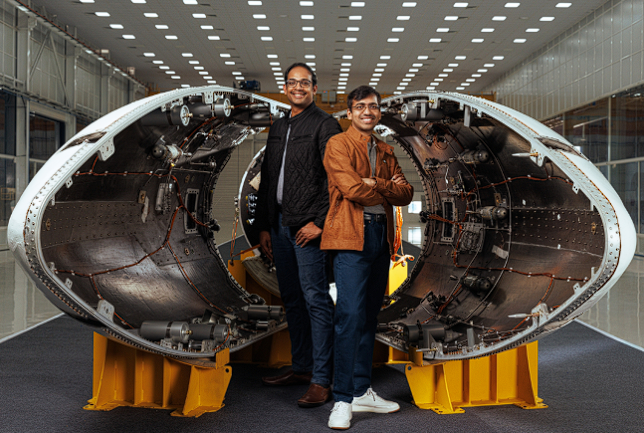
For a country long dominated by government-led space missions through Indian Space Research Organisation (ISRO), this moment signals something much bigger than just another startup funding round.
It represents the rise of India’s commercial space era.
From ISRO Engineers to Building India’s Private Space Future
Founded in 2018 by former ISRO scientists Pawan Kumar Chandana and Naga Bharath Daka, Skyroot Aerospace was created with a bold vision — making space launches faster, more affordable, and commercially accessible.
The startup first grabbed global attention in 2022 after successfully launching Vikram-S, India’s first privately developed rocket to reach space. That mission marked the beginning of a new chapter for India’s startup ecosystem and proved that private Indian companies could participate in advanced aerospace innovation.
Now, the company is preparing for an even more ambitious milestone: the launch of Vikram-1, India’s first privately built orbital rocket.
If successful, the mission could place Skyroot among a very small group of private companies globally capable of orbital launch operations.
Why This Matters for India
For years, the global commercial space industry has been dominated by players from the United States, China, and parts of Europe. Companies like SpaceX transformed space from a government-exclusive sector into a commercially scalable industry.
India is now trying to build its own version of that ecosystem.
In 2020, the Indian government opened the space sector to private participation, allowing startups access to ISRO facilities, testing infrastructure, and launch support. Skyroot became one of the first startups to formally partner with ISRO under this new policy framework.
The timing could not be better.
The global small satellite market is expanding rapidly due to:
- Earth observation systems
- Defense and surveillance technologies
- Internet satellite constellations
- Climate monitoring
- AI-powered geospatial applications
As satellite demand increases, launch services are becoming one of the most strategically important parts of the modern tech economy.
The Funding Behind the Unicorn Milestone
Skyroot’s latest funding round included participation from major global investors such as:
- GIC (Singapore sovereign wealth fund)
- Sherpalo Ventures
- BlackRock
- Greenko founders
- Arkam Ventures and others
This level of institutional backing sends a strong signal about growing international confidence in India’s deep-tech and aerospace ecosystem.
According to reports, the new capital will help Skyroot:
- Increase launch frequency
- Expand manufacturing capabilities
- Accelerate Vikram-2 development
- Scale commercial launch operations globally
Hyderabad Is Emerging as India’s Space-Tech Hub
Another important aspect of Skyroot’s story is geography.
The company is based in Hyderabad, a city increasingly becoming a major center for aerospace, defense, semiconductor, and deep-tech innovation.
Telangana’s startup infrastructure — including T-Hub and government-backed innovation initiatives — played a significant role in supporting Skyroot during its early stages.
The success of companies like Skyroot could encourage more Indian founders to build in highly technical sectors that traditionally seemed too capital-intensive or complex.
India’s Startup Ecosystem Is Evolving
For years, India’s startup narrative was dominated by:
- E-commerce
- FinTech
- Food delivery
- Consumer internet apps
Now, a new wave is emerging:
- AI
- Robotics
- Semiconductor manufacturing
- Defense tech
- Aerospace
- Climate tech
Skyroot becoming a unicorn reflects this larger transition.
Indian startups are no longer just solving convenience problems — they are beginning to build globally relevant infrastructure and frontier technologies.
That shift may ultimately define the next decade of Indian innovation.
Tepi AI’s Perspective
At Tepi AI, we believe Skyroot’s rise represents more than a funding milestone.
It shows what becomes possible when:
- policy supports innovation,
- technical talent gets opportunities,
- and startups are encouraged to solve ambitious problems.
India’s future startup leaders may not just build apps — they may build rockets, AI systems, climate technologies, and global infrastructure.
And perhaps most importantly, stories like Skyroot’s remind students across India that world-class innovation can be built here.
Not someday. Right now.
Sources: