
What Happened?
What if you could build an entire interactive 3D world with nothing more than a paragraph from a book and $10?
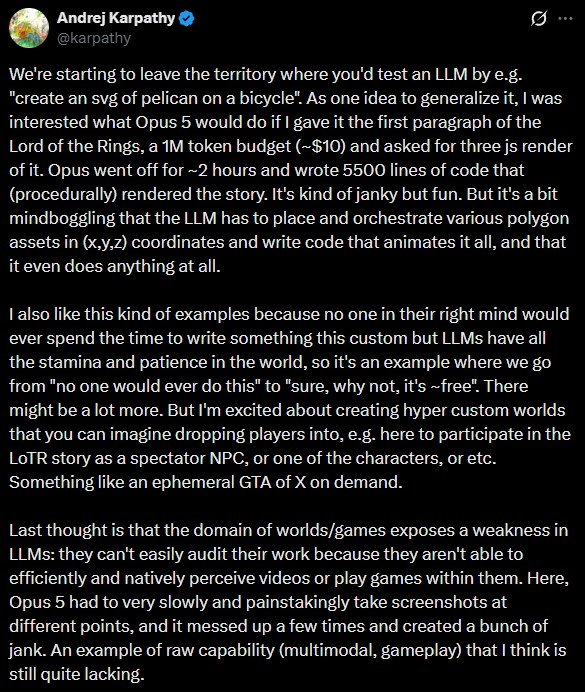
That’s exactly what happened when AI researcher Andrej Karpathy ran an experiment using Claude Opus 5. Instead of asking the model to answer questions or generate an image, he gave it the opening paragraph of The Lord of the Rings, a token budget of roughly $10 (around one million tokens), and a simple objective:
Build an interactive 3D version of this world using Three.js.
Then he walked away.
For nearly two hours, the AI worked completely on its own. It planned the project, wrote more than 5,500 lines of code, rendered a low-poly 3D fantasy world, captured screenshots of its progress, checked whether the output matched its expectations, fixed issues, and kept iterating until it produced a working experience.
The final result wasn’t perfect. Karpathy himself described it as a little “janky.”
But perfection wasn’t the point.
The real breakthrough was that the AI behaved less like a chatbot and more like an autonomous software engineer capable of planning, building, testing, and improving a project without constant human guidance.
Why This Is Bigger Than Just a Cool Demo
For years, AI demonstrations have mostly focused on answering questions, writing emails, creating images, or generating snippets of code.
This experiment represents something different.
Instead of completing one small task at a time, the AI handled an entire development workflow.
It wasn’t waiting for instructions after every step.
It made decisions.
It tested itself.
It corrected mistakes.
It kept working until the objective was complete.
That shift—from AI as an assistant to AI as an autonomous builder—could fundamentally change how software gets created.
Why Founders Should Care
This story isn’t about fantasy worlds.
It’s about startup economics.
Building an interactive product prototype traditionally requires:
- Hiring developers
- Working with designers
- Multiple review cycles
- Weeks of development
- Thousands of dollars
Now imagine describing your idea in plain English before going to bed and waking up to a functional prototype.
We’re not fully there yet.
But this experiment shows we’re moving much closer than most people realize.
The cost of turning an idea into software is dropping rapidly.
For early-stage founders, that changes everything.
The New Competitive Advantage
In the AI era, the biggest advantage may no longer belong to founders with the largest engineering teams.
Instead, it could belong to founders who know:
- How to communicate ideas clearly
- How to design great products
- How to evaluate AI-generated work
- How to iterate faster than everyone else
AI is reducing the cost of execution.
That means creativity, customer understanding, and product taste become even more valuable.
What This Means for Startups
If autonomous coding continues improving, startups could:
- Validate ideas in days instead of months.
- Build MVPs with much smaller teams.
- Test multiple product ideas before spending heavily.
- Launch faster while conserving precious runway.
- Spend more time talking to customers instead of waiting for development cycles.
This doesn’t eliminate engineers.
It changes what engineers focus on.
Instead of writing every line of code manually, they’ll increasingly supervise, improve, and architect systems built alongside AI.
But There Are Still Limits
It’s important to stay realistic.
The generated world wasn’t production-ready.
Complex applications still require experienced developers for architecture, security, scalability, debugging, and long-term maintenance.
Autonomous AI is a powerful accelerator—not yet a complete replacement for software teams.
However, every major technology shift starts with imperfect demonstrations.
The internet was slow.
The first smartphones were limited.
Early AI image generators looked unrealistic.
Today’s “janky” experiment could become tomorrow’s standard workflow.
Tepi AI’s Take
The most important lesson isn’t that AI built Middle-earth.
It’s that AI completed a complex software project with minimal human involvement for about $10.
That changes how founders should think about building companies.
The future won’t belong to the startups with the biggest budgets.
It will belong to the founders who know how to combine clear thinking, great product vision, and AI-powered execution.
If you’re still using AI only to summarize documents or write emails, you’re missing the bigger opportunity.
The next generation of startups won’t just use AI.
They’ll build with it from day one.
Original Source
Andrej Karpathy’s post on X: https://x.com/karpathy/status/2083749667410727319