When a former OpenAI executive joins the board of a rocket startup, it’s tempting to dismiss it as another executive career move.
That would be a mistake.
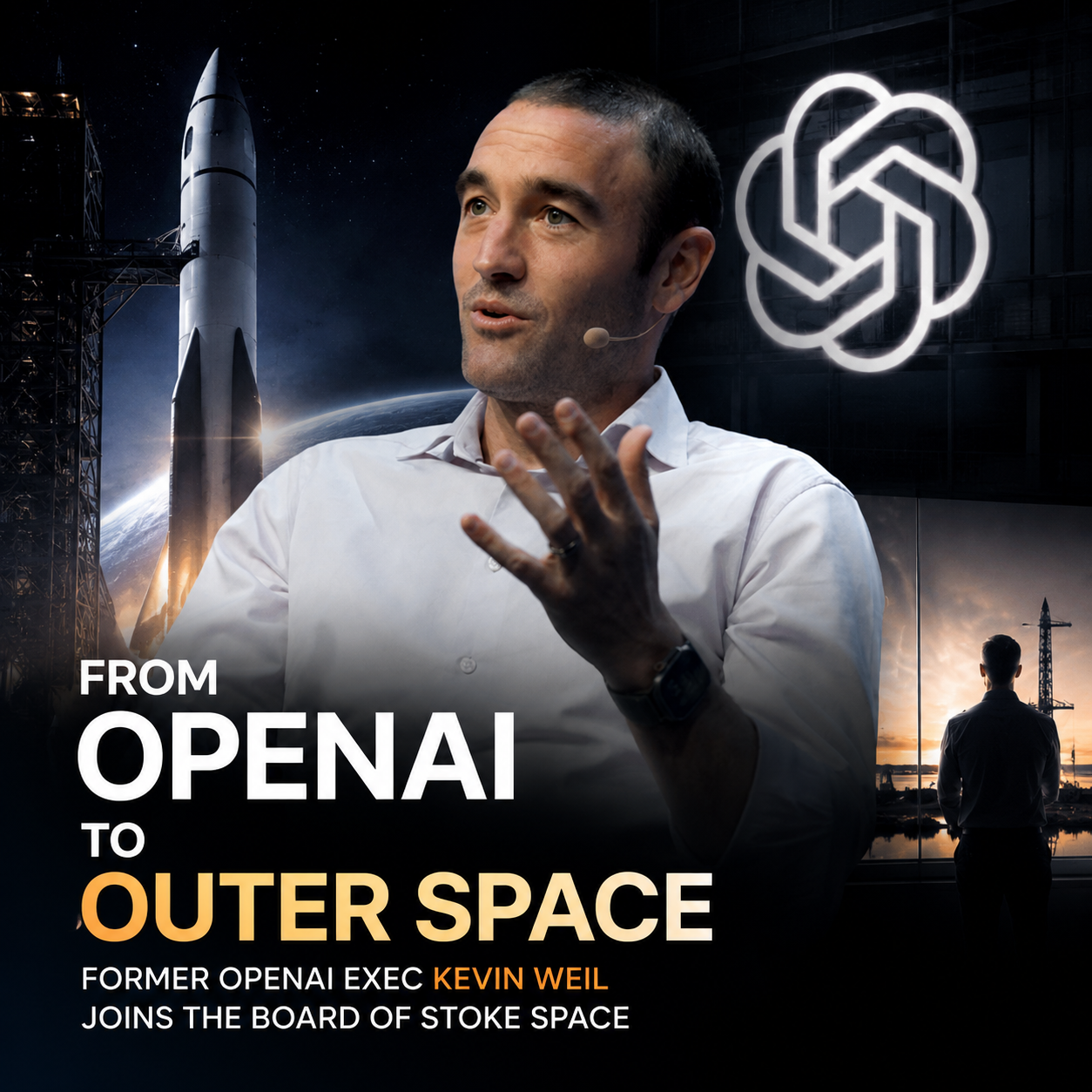
Kevin Weil, who previously served as OpenAI’s Chief Product Officer and later led OpenAI’s science initiatives, has joined the board of Stoke Space, a startup building fully reusable rockets. On the surface, AI and rockets seem like two completely different industries.
They’re not.
For founders, this isn’t really a story about space.
It’s a story about what investors, startup boards, and the next generation of deep-tech companies are starting to value.
Great Startups Don’t Just Need Great Technology Anymore
Stoke Space isn’t a small startup trying to prove an idea.
The company has already raised more than $1.3 billion, including a $510 million Series D round in 2025, to build fully reusable launch vehicles that compete with SpaceX.
At this stage, engineering alone isn’t enough.
Scaling a company requires different expertise.
Hiring Kevin Weil signals that Stoke Space isn’t simply building rockets anymore.
It’s building a long-term technology company.
Weil brings experience from:
- OpenAI
- Meta
- Planet Labs
Notice the pattern.
None of those companies manufacture rockets.
They specialize in scaling products, organizations, fundraising, and navigating hypergrowth.
That’s exactly the experience startups need once technology starts working.
Many founders think their next hire should always be another engineer.
Sometimes the next breakthrough comes from hiring someone who knows how to scale what already exists.
Deep-Tech Startups Are Becoming Business Companies
Historically, technical founders believed technical problems were their biggest challenge.
Today, that’s only half the story.
Modern deep-tech startups must solve:
- fundraising
- hiring
- government partnerships
- regulatory approvals
- manufacturing
- commercialization
Technology is only one piece.
The companies that dominate the next decade won’t necessarily have the smartest engineers.
They’ll have the strongest execution.
That’s exactly why experienced operators are becoming valuable board members.
Kevin Weil helped scale products used by billions of people before working on frontier AI.
Now he’s helping scale one of the world’s most ambitious aerospace startups.
Founders should pay attention.
This is becoming the new hiring playbook.
The Real Opportunity Isn’t Space
Space is simply the visible example.
The bigger trend is happening across the startup ecosystem.
AI executives are increasingly moving into industries like:
- healthcare
- biotech
- manufacturing
- robotics
- defense
- energy
- aerospace
Why?
Because AI is becoming infrastructure rather than the final product.
Every industry is being rebuilt using AI.
That means founders shouldn’t think of AI as a separate startup category anymore.
It’s becoming a capability inside every company.
Five years ago, adding an AI executive to a rocket company would have sounded unusual.
Today, it feels inevitable.
Tomorrow, it will be normal.
Founders building outside traditional software should see this as an advantage.
The companies that combine deep technical innovation with AI-first thinking will likely attract more attention from investors, partners, and customers.
What Founders Should Do Right Now
This announcement isn’t telling founders to build rockets.
It’s telling founders to rethink how they build companies.
Ask yourself:
- Does your leadership team only understand technology?
- Do you have advisors who have actually scaled companies?
- Are you preparing for growth before growth arrives?
Many startups wait until after raising funding to strengthen leadership.
The best founders prepare earlier.
Kevin Weil wasn’t brought in to write rocket software.
He was brought in because scaling companies is becoming just as important as building breakthrough technology.
That’s an important lesson regardless of your industry.
Whether you’re building an AI startup, applying for grants, joining an accelerator, or raising funding, investors increasingly evaluate whether your team can execute—not just invent.
Technology creates opportunities.
Execution creates enduring businesses.
Final Thoughts
Big startup stories often hide much bigger founder lessons.
Kevin Weil joining Stoke Space isn’t just another executive appointment.
It’s another signal that deep-tech companies are evolving beyond engineering-first organizations into businesses designed for long-term scale.
For founders, the takeaway is simple:
Build technology that matters.
Then build a leadership team capable of turning that technology into a company that lasts.
The startups that master both will shape the next decade of innovation.
Discover More Founder Opportunities
The biggest startup opportunities are often hidden inside stories that most people simply scroll past.
At Tepi AI, we break down funding news, AI trends, accelerators, grants, venture capital, and the startup ecosystem into actionable insights that help founders build faster.
Read more founder-focused insights at: https://tepiai.com